Editorial Essay
Organizing China's Delivery Workers
- Published
- September 4, 2024
- Read Time
- 2 min read
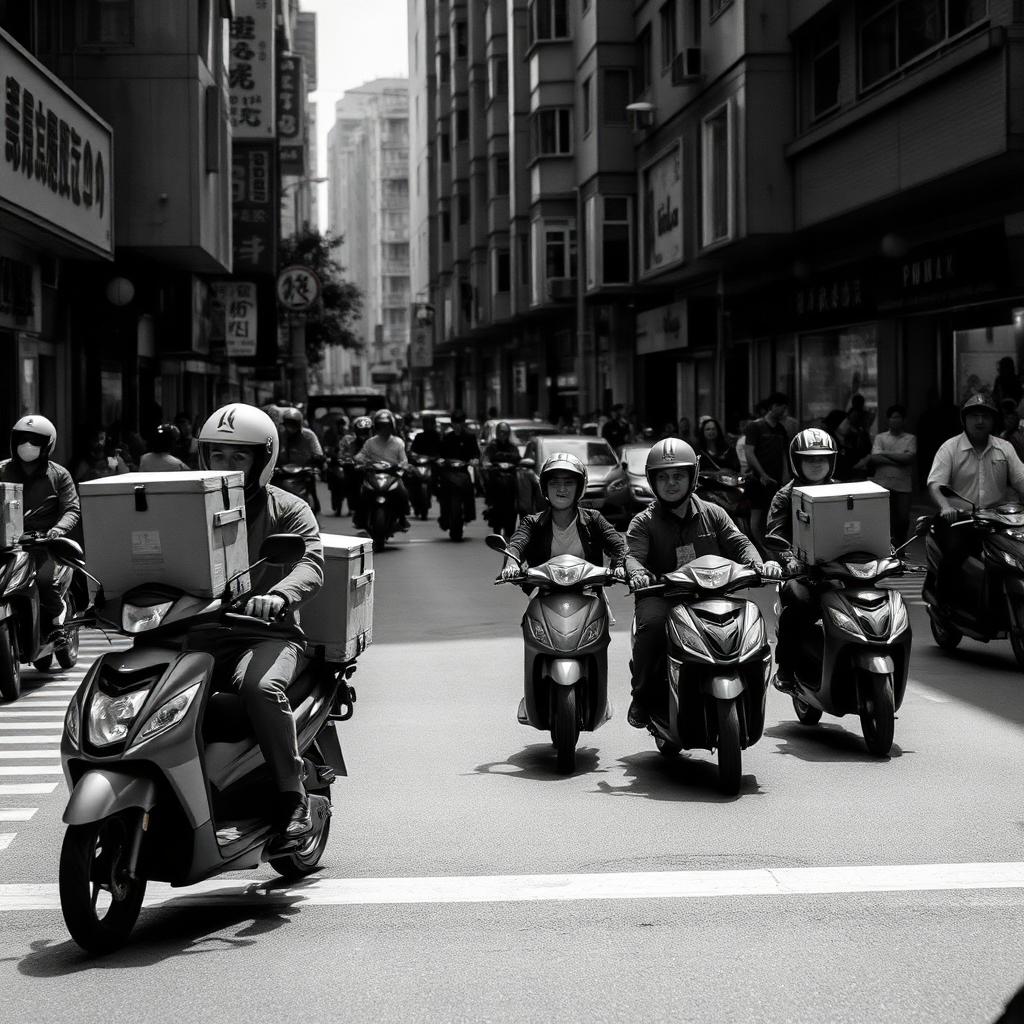
How the first digital food-delivery worker trade unions took shape in Shanghai, and what it means for the gig economy.
On January 1, 2016, the Shanghai Putuo District Trade Union chartered China's first formal trade union for food-delivery riders: the Putuo District Online Food Delivery Union Federation, representing roughly 16,000 workers at third-party companies partnering with Ele.me. The move received almost no attention outside specialist circles at the time. It represents one of the more consequential experiments in platform-era labor policy anywhere in the world (Ness, Dialectics of Chinese Labor, pp. 123–124).
The riders themselves — many of them internal migrants, working under algorithmic dispatch for Meituan and Ele.me — had organized informally for years, using WeChat groups to coordinate slowdowns and share information about pay rates. The formal union status changes the register of that organizing: platform companies now have a state-recognized counterparty when disputes escalate (Chau 2022; Ness, Dialectics of Chinese Labor, pp. 116–117).
That counterparty relationship has since produced concrete concessions. In August 2022, Shanghai's and Yangpu District's federations of trade unions prevailed on Meituan to expand democratic management for workers in these new employment forms — a mechanism for mediating disputes and raising compensation and working conditions, not just a symbolic recognition. By 2024, a three-year union drive launched in 2021 had organized 18.3 million new union members among logistics, digital, and new-economy workers nationwide (Ness, Dialectics of Chinese Labor, p. 126).
The model has scaled well beyond that first Shanghai local. By July 2023, the ACFTU reported that couriers, ride-hailing drivers, and other workers in “new forms of employment” had reached 84 million nationwide, and the federation launched a Three-Year Action Plan (2023–2025) to deepen union mobilization in the sector — building on an earlier, high-profile push to unionize ride-hailing giant Didi Chuxing beginning in 2021 (Ness, Dialectics of Chinese Labor, p. 109).
It is too early to call this a template. But it is a live case against the assumption that gig work is inherently unorganizable, and it deserves closer attention from anyone thinking about the future of platform labor beyond China.
It's a pattern that echoes the slower, more diffuse organizing already reshaping Guangdong's industrial zones.
About the Author

Immanuel Ness is Distinguished Professor of Sociology at the University of Johannesburg and author of Dialectics of Chinese Labor.